
• WayAhead Directory
  • Understanding Anxiety
  • Mental Health Month
  • PNDA
  • WayAhead Workplaces
  • Membership

WayAhead

Mental Health - Education, Support and Prevention

  • About Us
    • Who we are
    • Strategic Plan
    • Diversity and Inclusion Strategy
    • Board Members
    • The Team
    • Supporters
    • Public Statements
      • WayAhead welcomes Federal Government’s $100 million youth mental health funding announcement
      • 2017 Mental Health Matters award winners announced
      • OCD and Anxiety Awareness Week 2017
      • Marriage equality debate, our message to the LGBTI community
      • NAIDOC Week
      • Diversity and Inclusion Strategy
      • IDAHOT Statement
      • Top 5 ways to support employee’s mental health 
      • WayAhead’s Response to the 2017 Federal Budget
    • Annual Reports
      • 2017
      • 2016
      • 2015
      • 2014
      • 2013
      • 2012
      • 2011
      • 2010
    • Sign Up to our eNews
    • Shop
      • Books
        • Anxiety
        • Attention Deficit Disorder
        • Bipolar
        • Depression
        • Drugs and Alcohol
        • Obsessive Compulsive Disorder
        • Psychosis
      • Membership
  • Get Involved
    • Membership
      • Members Log In
    • Sign Up to our eNews
    • Donations, philanthropy, bequests
    • Volunteer
    • Become a Facilitator
    • Work for us
  • Facts & information
    • Fact Sheets
      • Mental Illness and Related
        • ADHD
        • Agoraphobia
        • Alcohol and Other Drugs
        • Alcohol related harm
        • Antisocial Personality Disorder
        • Anxiety
        • Bipolar Disorder
        • Body Dysmorphic Disorder
        • Borderline Personality Disorder
        • Depression
        • Domestic and Family Violence
        • Drug Induced Psychosis
        • Eating Disorders
        • The Empty Nest Syndrome
        • Factitious Disorder
        • Generalised Anxiety Disorder
        • Loss and Grief
        • Medicare Rebates and Accessing Private Practitioners
        • Mental Health Act 2007
        • Mental Health During Pregnancy and Early Parenthood
        • Mental Health Care for Immigrants
        • Mental Health Jargon
        • Obsessive Compulsive Disorder
        • Panic Disorder
        • Paranoia
        • Post Traumatic Stress Disorder
        • Psychosis
        • Schizophrenia
        • Self-harm
        • Social Anxiety
        • Who Can Help and How?
      • Supporting and Caring
        • Caring for a Parent with a Mental Illness
        • Help! It’s out there
        • How is your Mental Health?
        • Looking After Yourself and Your Family
        • Stigma
        • Understanding the Illness
        • When someone needs help but is not willing to get help
        • Where to Seek Support
        • Who Can Help and How?
        • Your GP and Mental Health Care
      • Maintaining Well-being
        • 10 Tips to Stress Less during the Holidays
        • Cyber Bullying
        • Building Resilience
        • Learn & Grow
        • Mindfulness
        • Physical Activity and Health
        • Physical exercises for older people to improve wellbeing
        • Recognising and Managing Stress
        • Release, Respond, Rethink
        • Sleep and Health
      • Translations
        • Bengali বাংলা
        • Simplified Chinese 简体中文
        • Nepalese नेपाली
    • WayAhead Directory
    • Telephone Support Lines
    • Wallet Cards
    • Understanding Anxiety Forums
    • Stress Less Tips
  • Anxiety Programs
    • Support Groups
      • Support Group meetings Calendar
      • Support Group locations
      • What happens at a Support Group Meeting?
    • Small Steps Seminars
    • Understanding Anxiety Forums
  • Mental Health Promotion
    • Mental Health Month
    • Mental Health Matters Awards
    • Stress Less Tips
    • WayAhead Workplaces
    • Perinatal Depression and Anxiety Awareness Week
    • OCD and Anxiety Disorders Awareness Week
    • Speaker Series
  • Forums
    • Lived Experience Forum
    • Carers Forum
  • Mind Reader
    • CEO Reports
    • Feature Stories
    • Lived Experience Stories
    • Research
    • Mental Health News
    • WayAhead Work

It’s Summer Time: We Need to Talk About ‘Summer Bodies’ and Body Image

December 18, 2017

Summer is now officially here, with the weather warming up around Australia. As the layers are shed and people start heading towards the beach, certain phrases start cropping up:

“Beach Body in 7 Days!” from the Women’s Health Magazine.

“Get Your Summer Body Now!” from Oxygen Magazine.

To be fair, other magazines do fare slightly better: “Crush Your Life Goals: Get a strong bod” Cosmopolitan

But from magazine covers to TV to the online sphere, there are strong social cues that it is summer time and that your body needs to look a certain way to enjoy it.

WayAhead spoke to the Butterfly Foundation, an organisation dedicated to providing support for people with disordered eating and body image issues, about this phenomenon and the risks of this increased pressure on body image across both on social media, traditional media and other advertising platforms.

“Over the festive season, Butterfly’s National Helpline tends to see an increase in the number of calls and webchats. There is an increase in advertisement and hashtags focusing on ‘bikini bodies’, ‘shredding’, ‘summer bodies’, dieting and exercising. We have constant access to images of people, their food, their lives and quite frequently their bodies,” a spokesperson for the Butterfly Foundation said.

“This can lead to unhelpful comparisons, pressure to achieve a certain body type and may contribute to body dissatisfaction. Advertisements such as these may encourage [people] to ‘fix’ or ‘alter’ their appearance rather than seeking health professional advice,”
Dr Jennie Small, a Senior Lecturer at the University of Technology, Sydney, wrote a research paper last summer analysing the phenomenon of women’s “beach body” in Australian magazines. Dr Small’s research found that throughout the year, women’s magazines focused on women’s bodies in a myriad of ways – hair, skin, make-up, body shape and clothing – but during the summer, the focus was specifically on the “summer beach body”. The magazines implied that women’s bodies are on display during the summer, and by repeatedly showing pictures of slim, toned muscles and fit bodies in bikinis, these magazine covers targeted women’s feelings of insecurity which ultimately made it easier for marketers to sell things to women.

In fact, the popular concept of a “bikini body” was actually created as part of a marketing campaign from the 1960s for a weight loss company called Slenderella. Their tagline at the time it was created was: “High firm bust – hand span waist – trim, firm hips – slender graceful legs – a bikini body!”

While these specific words are no longer as widely used, the concept of a bikini body remains fairly similar. This is reflected in Dr Small’s research, which concluded that the favoured body shape is slim (no larger than an Australian size 12), toned, tanned and fit. Dr Small recognised that the characteristics of the summer body have broadened in recent years, but the changes have been slight.

Advertising in Australia is mostly self-regulated with a code of conduct. While the code adopted by the Australian Association of National Advertisers (AANA) regulates the use of models in bikinis, the regulation itself refers to the use of nudity and whether the portrayal of people depicted is discriminatory. The code does not have clear guidelines on how bodies are portrayed and how this may negatively affect viewers. Many of these marketing images, which come under this regulation, and the ones on social media, which do not, are professionally shot, airbrushed or digitally enhanced. It is unrealistic for viewers to compare they way they look to these models and social media influencers.

The Butterfly Foundation recognises that there is a positive aspect to social media through raising awareness around good mental health and wellbeing, and through creating spaces where people can connect and reach out for help.

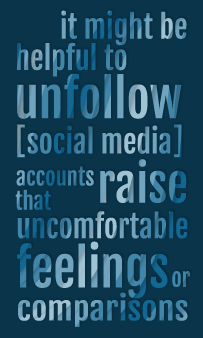
However, they also recommend that people consider which accounts they follow and that it might be helpful to unfollow accounts that raise uncomfortable feelings or comparisons.

“Monitor the changes in your mood after doing this – it’s a simple change but an effective way of controlling what we are viewing and its influence on our self-esteem and body image,” a spokesperson for the Butterfly Foundation said.

If you, or anyone you know is experiencing an eating disorder or body image concerns, you can call the Butterfly Foundation National Helpline on 1800 33 4673 (ED HOPE) or email support@thebutterflyfoundation.org.au

By Cindee Duong


Back to most recent edition

Share this:

  • Click to share on Twitter (Opens in new window)
  • Click to share on Facebook (Opens in new window)
  • Click to share on Google+ (Opens in new window)

Filed Under: Mental Health Matters, MHMSummer17/18, Opinion Tagged With: Body Image, Butterfly Foundation, Festive Season, Media, Mental Health, Self-esteem, Social Media, Summer

Thanks for reading

Your feedback and contribution to WayAhead is appreciated.

Please let us know of any ways we can improve this website.

Get Support

Mental Health Support Line

1300 794 991

Anxiety Disorders Support Line

1300 794 992

5 days a week

9.00 - 5.00pm

Contact

Level 5, 80 William St
Woolloomooloo NSW 2011

info@wayahead.org.au

General Enquires:
(02) 9339 6000

Finance:
(02) 9332 0218

Human Resources:
(02) 9332 0241

Communications:
(02) 9339 6006

Website by

WayAhead is an ACNC registered Australian Charity and is endorsed by the Quality Improvement Council.

Supported by

WayAhead Websites

WayAhead Online Directory

Mental Health Month

Understanding Anxiety

WayAhead Workplaces

Stress Less Tips

Perinatal Depression and Anxiety

Connect with Us

  • Facebook
  • Instagram
  • Twitter
  • YouTube

© Copyright 2016 WayAhead - Mental Health Association NSW · All Rights Reserved ·