
Behind the Photographer’s Lens
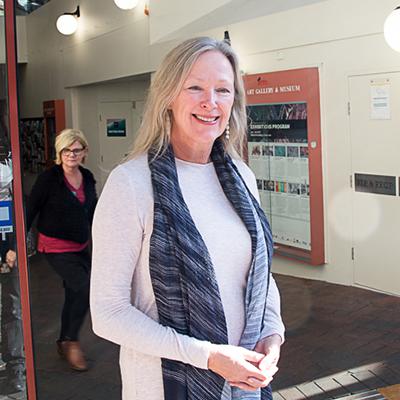
Photographer – Jennifer Blau
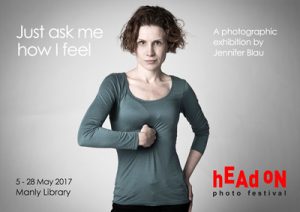
Last month, documentary photographer, Jennifer Blau, exhibited her portraits of people who had had an eating disorder in the series Just ask me how I feel, created in partnership with WayAhead. The portraits were shown at Manly Library as part of the international Head On photo exhibition that runs in Sydney every year.
Since we worked with Jennifer on this project as well as a video installation for Parramatta Library on eating disorders for Mental Health Month 2016, we thought it would be fascinating to get to know what makes the person behind the lens tick.
What made you want to work with WayAhead to create your portrait exhibition Just Ask Me How I Feel?
 There were a couple of reasons…
Although no one in my family has experienced an eating disorder I have close friends whose children have been, and the effect can be devastating. So, at the very least, I hoped that this work might help someone.
It had also been a while since my last documentary portrait series because I’ve been doing a Masters in Art Therapy the last couple of years. I’d been wanting to re-engage with photography and work on a new portrait project and when Matthew Keighery at WayAhead suggested this to me, it seemed to dovetail my interests in photography and therapy. Within art therapy I’ve been learning about eating disorders.
One of the things I enjoy about portrait photography is the connection with my subject. It can be a privilege to be allowed into someone else’s world. People often feel quite vulnerable as they reveal themselves before the camera. So, in a similar way to establishing a safe place for a client in therapy, I aim to be sensitive to their needs for them to feel safe in my presence. The best portraits, I believe, always show some emotion in the subject and so this connection with subject is vital. For this series, I also asked the subjects to try to convey to me what they felt in their body when they experienced the feelings associated with the eating disorder.
[metaslider id=4692]
You’ve photographed people who are often overlooked or underestimated by society, like women over 50, teenagers, people experiencing homeless and now those affected by eating disorders. What draws you to these subjects?
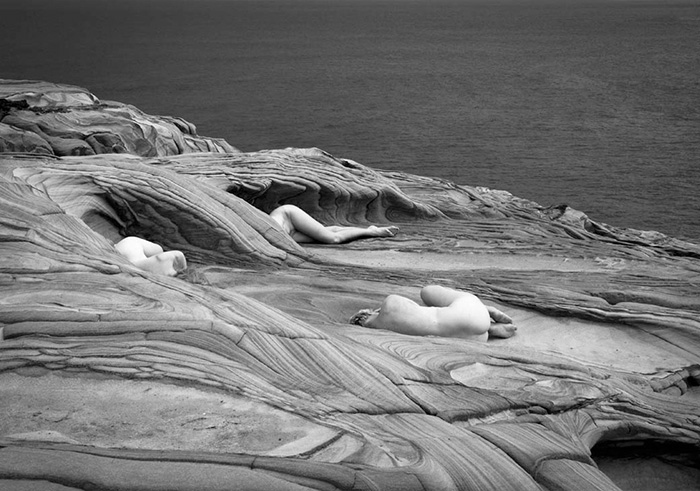
I’ve been interested in exploring ideas about identity, how people portray and perceive themselves. My work on teenager’s bedrooms was about how the bedrooms reflected the important and growing need for self expression and quest for identity – despite their parents’ obsession with the mess. With the women over 50, in my book The 50 Book: Women Celebrate Life, I explored the change of identity that occurs as women age, youth and beauty fade and significant roles, such as being nurturing mothers, subside. Women at this age can begin to feel worthless and invisible (or, conversely, liberated). I’m interested in transitions in life but also I think it’s important to show that what someone is currently experiencing does not necessarily define them, that there is a person underneath the label, whether you’re a defiant teenager, an empty nester, homeless or anorexic and everyone has similar emotions. I think that being photographed can help those who may feel misunderstood, undervalued or invisible feel acknowledged and validated. This has certainly been the case with people experiencing homelessness who I’ve photographed with Sydney Homeless Connect for the last six years (this work was exhibited at the State Library of NSW in 2013). It is always a wonderful experience to see the pleasure they receive in seeing themselves presented in a positive light, often in new clothes and a new haircut provided by other volunteers. We all like to have a good photograph of ourself as it boosts our self image but when going through difficult times it is even more important to counter negative feelings. Another area I’m also interested in further exploring is whether portrait photography might help people with body dimorphic disorders reconcile how they perceive their bodies.
[metaslider id=4686]
What role do you think photography plays in broader conversations about social issues here in Australia?
As a documentary photographer (I did a masters in documentary photography at Sydney College of the Arts a few years ago) I am interested in people and their stories and the powerful way in which one still image remains tangible (as opposed to video images which are fleeting), can communicate so much, touch people emotionally, raise awareness and open a dialogue about important social issues related to marginalisation, diversity, inequality, including of course the stigma of mental illness. Platforms such as the Head On Photo Festival are fantastic as they allow so many important issues to be canvassed photographically and ever-increasing numbers of the public attend their exhibitions. As an example, Manly Library had 30,000 people viewJust Ask Me How I Feel so the marriage of the festival and community audience has enormous potential for creating awareness. Head On is now a significant international photo festival and attracts contributors from all over the world. Sadly, documentary photography is increasingly undervalued in the mainstream media especially with recent cutbacks in print journalism and to the work of photojournalists and so photographers need to find alternative ways of communicating.
You have a really interesting background, with an undergraduate degree in media and psychology, as well as experience working in publishing for children. How do these inform your photography work?
Yes, I started life studying both psychology and media but despite an ongoing interest, deviated from the psychology path until recently. I worked in TV, radio and then book publishing for 25 years firstly as a photo editor and picture researcher and later as a senior editor in illustrated books working in both adult non-fiction and children’s books. I’ve been lucky to have spent most of my working life looking at some of the world’s best images – both photographic and illustrative on all sorts of subjects – and incorporating them as a counterpart to the text in books I’ve worked on. So visual communication has always been important to me and the interplay between words and image has informed my work in books, my photographic work which is often supported by my subject’s words, and interestingly now my work in art therapy where nonverbal expression also works in tandem with talking therapy.
For you, what is the value in art therapy and what made you decide to pursue further study in it?
I have always had a yearning to pursue both counselling and photography and when I first heard of art therapy it seemed to combine both interests. Art therapy is a way of accessing unconscious material working creatively with the imagination. Lots of photographers (and other artists) pursue personal psychological themes in their work so I was curious to know how/whether photography might be incorporated into therapy. It can be used as therapeutic photography as a kind of self-help or can be used as a vehicle for expression and discussion with a therapist. So I am hoping to explore art therapy with a focus on using photography as a medium because photography is so accessible and ubiquitous. I’ve begun doing this with drug and alcohol rehab clients in my clinical placement.
What are you working on next and where can we see some of your other work if we missed the exhibition at Manly Library?
I’m not sure what is next for me but am committed to continuing with documentary photography and hopefully marrying this with my interests in mental health. Some of my work can be seen on my website jenniferblau.com and also in my book The 50 Book: Women Celebrate Life at the50book.com
By Tasnim Hossain

Newsletter
Stay up to date
Sign up to our Mind Reader newsletter for monthly mental health news, information and updates.